

Dear Android Makers, the iPhone 5S Is Getting iOS 12
Android smartphones have never really been known for stellar software support. Most Android phones become upwards to 2 years of software updates, some fifty-fifty become just 1 major update in their entire life-wheel before they are forgotten by the OEMs, and abandoned to lie forever in the wasteland that is older Android versions.
iPhones, on the other hand, have always had an excellent tape with software updates. Apple's claims about putting the consumer first may sound a lot like brain-washing and tall-claims, just the Cupertino behemothic has never faltered in its quest to push button out software updates to equally many devices as it possibly can. I'1000 talking, of grade, about the recently announced iOS 12, and the not-then-recently-announced Android Oreo.
It Always Begins at WWDC
Every year, without fail, Apple takes the stage at its Earth Wide Developers' Conference and pokes fun at the miserable adoption charge per unit of the latest iteration of Android. Information technology's ordinarily Craig Federighi taking the mickey out of Android OEMs, and while most Android users see this as Apple'southward way of showing Android down, believe me, it's actually not. Heck, Apple doesn't demand to testify Android equally a low-grade OS when it comes to adoption ratio, and the sort of support Android makers offer their customers.
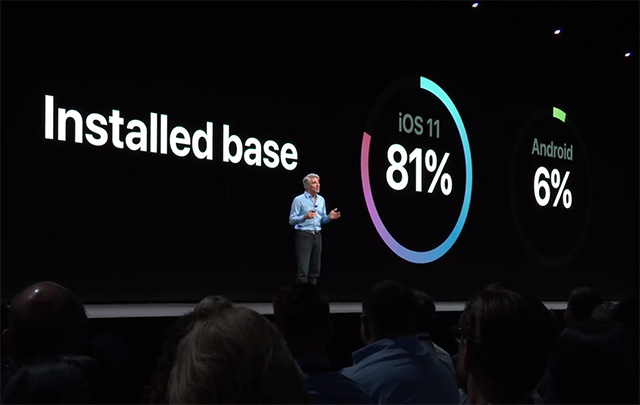
This year likewise, at WWDC 18, the figures were every bit skewed as they've always been. iOS 11 has been installed on a whopping 81% of all iOS running devices; and where does Android stand? A meager 5.7% of Android devices are running Android Oreo. Yeah, 5.7%. Apple may have been kind and rounded information technology up to 6% at the keynote, but information technology's 5.7% past Google's own numbers and it's consistently been this bad for the Mountain View giant'south smartphone OS.
Too Many Android Devices? Your Statement Is Invalid
The most common statement that Android fanboys use to justify this skew in numbers is "there are merely too many Android devices, and Apple simply makes flagships."
It's true, patently. Apple only makes flagships, and there really are a maddeningly large number of Android devices across all toll ranges out there. So let's look at simply the flagships.
iOS 12 is coming to almost every iOS device imaginable. The oldest iPhone that will be receiving the iOS 12 update is the iPhone 5s. Yep, you read that right. A five year sometime iPhone will be getting support for the latest iteration of iOS.
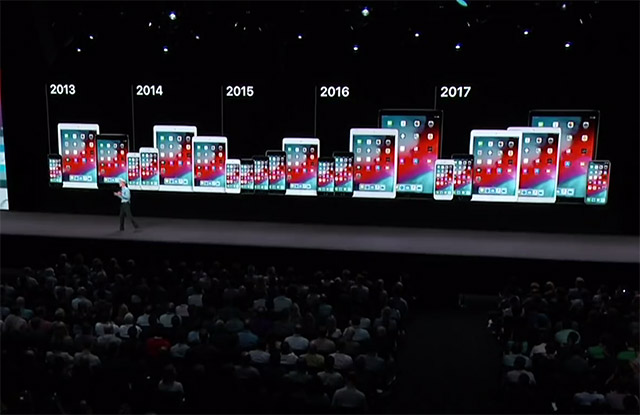
When the iPhone 5s was launched back in 2013, it had some really big competitors out there from every major Android player in the market place. There was the Milky way S4, the LG G2, the Galaxy Note 3, the HTC One, the Nexus v, and the Xperia Z. Let me take that veil off your eyes and show you exactly where those flagship smartphones from Android OEMs ended up.
Galaxy S4
The Galaxy S4 was launched in 2013, same every bit the iPhone 5s, and it came with Android 4.2.2 Jellybean out of the box. In 2014, Android five.0 (Lollipop) was released, and truthful to the 'flagships obviously get upgrades' philosophy the Galaxy S4 received an update. And then Android 6.0 Marshmallow came out, Android vii.0 Nougat came out, Android 8.0 Oreo is here at present, and the Galaxy S4 didn't receive any 1 of those upgrades… not officially at to the lowest degree.
That'due south probably because Samsung launched the Milky way S5, and wanted people to buy that shiny new phone with its infamous band-assist design back. Whatever the reason may have been, the Milky way S4 lay abased merely 1 year into its life.
HTC One
The HTC flagship from 2013, is yet another example of how flagship phones will obviously get longer back up from OEMs. The HTC One came with Android 4.1.2 Jellybean out of the box, and the last official update it received was Android five.0 Lollipop. In 2014.
Nexus v
The Nexus 5 was also released in 2013, packing Android iv.0 Water ice Cream Sandwich, and it got updated to Android Marshmallow. It's non nearly as bad as what other flagship smartphones of the time were, and that'due south thanks to the fact that it's a Nexus device and then it got a piffling extra in the style of Android upgrades. All the same though, Marshmallow was released in 2015, and that's non as well adept.
Xperia Z
Yet another flagship from 2013, the Xperia Z from Sony also came out with Android iv.i.2 Jellybean back in the day and was later updated to Android 5.1.1 Lollipop. Since so? Well, while independent developers and ROM builders may have extended unofficial AOSP ROMs for the Xperia Z (and other phones in the list), merely officially the Xperia Z was abandoned by Sony.
Milky way Note 3
Afterwards in 2013, Samsung also released the Galaxy Note iii — a trend that is still very much in play — and the device came with Android four.3, to be updated as far as Android 4.iv. The Note 3 had some pretty decent hardware for its time, and Samsung could have (and should have) supported it for longer than that meager time that it was supported for.
LG G2
LG'south flagship from 2013 — the LG G2 — as well came out with the latest and greatest Android version of its fourth dimension — Android iv.two.ii Jellybean. The flagship smartphone was later on updated as far as Android 5.0.two — not a corking record by any means, heck non even a decent one, merely better than the Notation 3 at the very least.
It's a very easily observable trend among Android smartphones to get software support for no more than than a year, or maybe 2 at max. Now, you may merits that people usually switch phones in a year's time anyway, and you, dear reader, would exist wrong.
According to Google's stats, a majority of Android smartphones are running Android Nougat (31%), followed by Marshmallow (25.five%), followed by Lollipop (22.iv%), followed by KitKat (10.iii%) — that obviously implies people are sticking with their phones even when they're way older than ane twelvemonth. Also note that Android Oreo is on 5th place with 5.7% phones running the software.
you may claim that people usually switch phones in a year's fourth dimension anyway, and yous, honey reader, would be wrong
That's really not how software updates are supposed to work, and honestly there'due south something incredibly wrong with the way Android makers are handling updates.
Newer Android Devices
Things haven't really improved with fourth dimension for Android flagships. Hither's a listing of smartphones that were released in 2016 and 2017 along with the Android version they were launched with, and the latest update they received. I've also added the time difference betwixt the Oreo launch, and the mean solar day when these phones received the Oreo update (where applicable). Check information technology out:
Major Smartphones in 2016
| Smartphone Name | Initial Android Version | Last Android Update | Time Taken to Receive Oreo Update |
|---|---|---|---|
| Galaxy S7 | Android half-dozen.0 Marshmallow | Android 8.0 Oreo | x months |
| HTC 10 | Android 6.0 Marshmallow | Android 8.0 Oreo | 5 months |
| OnePlus 3T | Android 6.0 Marshmallow | Android eight.0 Oreo | 3 months |
| Xperia XZ | Android 6.0 Marshmallow | Android 8.0 Oreo | 3 months |
| ZenFone 3 Deluxe | Android half dozen.0 Marshmallow | Android 8.0 Oreo | 5 months |
| Moto Z Force | Android six.0 Marshmallow | Android 8.0 Oreo | ix months |
| Google Pixel | Android 7.1 Nougat | Android viii.0 Oreo | 0 days |
| Redmi Notation 3 | Android v.1 Lollipop | Android 6.0 Marshmallow | NA |
| Moto G4 Plus | Android half dozen.0 Marshmallow | Android 7.0 Nougat | NA |
| Honor 6X | Android half-dozen.0 Marshmallow | Android seven.0 Nougat | NA |
Major Smartphones in 2017
| Smartphone Name | Initial Android Version | Latest Android Version | Time Taken to Receive Oreo Update |
|---|---|---|---|
| Galaxy Note 8 | Android 7.ane Nougat | Android eight.0 Oreo | 7 months |
| Milky way S8 | Android 7.0 Nougat | Android 8.0 Oreo | 6 months |
| HTC U11 | Android 7.1 Nougat | Android eight.0 Oreo | 5 months |
| OnePlus 5T | Android 7.1 Nougat | Android eight.0 Oreo | 5 months |
| Xperia XZ1 | Android eight.0 Oreo | NA | NA |
| Nokia eight | Android vii.1 Nougat | Android 8.0 Oreo | 3 months |
| ZenFone 4 Pro | Android 7.1 Nougat | Android viii.0 Oreo | 7 months |
| Moto Z2 Force | Android 7.1 Nougat | Android eight.0 Oreo | 5 months |
| Google Pixel ii | Android eight.0 Oreo | NA | NA |
| Redmi Note 4 | Android 6.0 Marshmallow | Android 7.0 Nougat | NA |
| Moto G5 Plus | Android 7.0 Nougat | Android viii.1 Oreo expected in July 2018 | 11 months |
| Nokia 5 | Android seven.1 Nougat | Android 8.0 Oreo | v months |
| Honor 7X | Android 7.0 Nougat | Android 8.0 Oreo | 9 months |
Equally you can see, flagships from 2016 and 2017 are getting Android Oreo, but they're getting it months afterward the OS was officially released. Other than the OnePlus 3T, and the Xperia XZ, all other phones have taken 5 months or longer to get the Oreo update. In fact, the Moto G5 Plus is notwithstanding waiting on Oreo, and is expected to get it next calendar month, in July 2018.
What'south more than is that none of the 2016 flagships will get updated to Android P, other than the Pixel, and that's just sad. Android P is the Android update from 2018 and it should exist fabricated bachelor to smartphones that are less than 2 years quondam at this point.
iOS 12 on iPhone 5s Works Flawlessly
By now, I'm pretty certain the simply argument remaining would be that after the absolute dumpster-fire that iOS xi was, how can a 5 yr old iPhone even begin to handle iOS 12, and that's where Apple'due south absolute control over its hardware and software shows its merits.
Apple, thanks to the fact that it knows exactly the devices the OS is supposed to be working on, can optimize it that much ameliorate for its devices. At WWDC, when iOS 12 was announced, Apple specifically mentioned that older iPhones will play well with iOS 12. Now I won't lie to you lot, I doubted the claim, especially afterwards having suffered with iOS xi on an iPhone 6S, just I installed the iOS 12 Programmer Beta on my iPhone 5s, and it looks like the company wasn't lying most the improvements. Apps open up faster, the photographic camera loads up quicker, the keyboard, the control center, the animations, everything is simply better with iOS 12. Keep in listen that this is a Developer Beta, not even the Public Beta, so I'thou pretty much expecting a good future for iOS 12.
So yeah, you may argue that iPhones are inherently way more expensive than most flagships of their time, but at that place's no denying that for the price, Apple does offering incredible software support, and gives y'all the ability to employ your iPhone for far longer than you'd be able to apply an Android phone.
Run across Besides: 15 Best New iOS 12 Features You Should Know
The Land of Android: It's Getting Screwed, and Project Treble Is Our Only Hope
I'1000 pretty sure Google has recognized this, for the lack of a better word, train-wreck that's Android updates across the ecosystem. After all, the company announced Project Treble with the sole intention to brand rolling out Android updates easier and faster, and a lot of companies are getting on lath Treble now, and so maybe we can expect meliorate software support on Android soon, too.
At the very least, however, I expect Google's Pixel devices to get a software lifecycle that's longer than the 3 years that Google currently guarantees. It shouldn't be this hard for a company to back up its flagship devices for a longer menstruation of fourth dimension.
Don't get me wrong, I'thou not telling anyone to not buy an Android phone. If you want an Android phone, by all ways, become out and get it. Hell, I'thousand using an Android phone right now too. The point of this entire article was to emphasize how terrible the state of Android updates currently is. In that way, Apple'south consolidated lineup of devices is a much better way for the company to offer its customers the best possible software support.
Well, here's hoping Project Treble turns out to exist the savior that Android so desperately needs to get updates rolling out quickly and smoothly. With Android P, things are looking better already with a number of 3rd-political party companies pushing out Android P Developer Previews to their flagship smartphones, and perchance we can expect Android to slowly, but surely get to a stage where within a year of its launch, 81% of Android smartphones are running the latest software. I'll go on my fingers crossed till then.

Source: https://beebom.com/dear-android-makers-iphone-5s-getting-ios-12/
Posted by: mccurryyoureaturs.blogspot.com
0 Response to "Dear Android Makers, the iPhone 5S Is Getting iOS 12"
Post a Comment